
Concept of Power Electronics
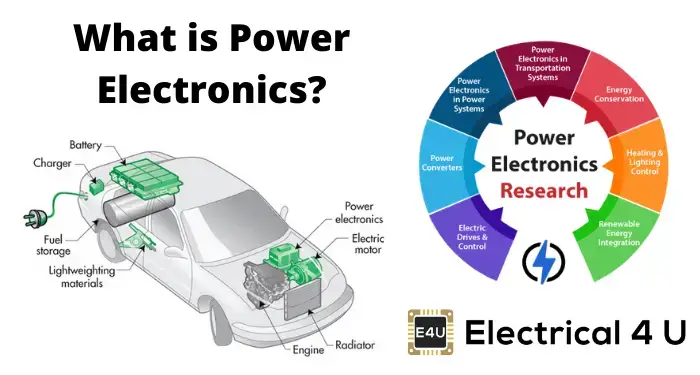
Power electronics is one of the contemporary subjects of electrical engineering which has seen a lot of advancements in recent times and has impacted human life in almost every sphere. We over selves use so many power electronic applications in our daily life, without even realizing t. Now the question stands as, “what is power electronics?”.
We can trace the overwhelming advancement in the subject back to the development of commercial thyristors or silicon controlled rectifiers (SCR) by General Electric Co. in 1958. Before this the control of electrical energy was mainly done using thyratrons and mercury arc rectifiers which works on the principle of physical phenomena in gases and vapours.
After SCR, a great many power electronic devices have emerged like GTO, IGBT, SIT, MCT, TRIAC, DIAC, IEGT, IGCT and so on. These devices are rated for several hundreds of volt and ampere unlike the signal level devices which work at few volts and mill amperes.
In order to achieve the purpose of power electronics,
the devices are made to work as nothing more than a switch. All the power electronic devices act as a switch and have two modes, i.e. ON and OF
For example, a BJT (Bipolar Junction Transistor) has three regions of operation in its output characteristics cut-off, active and saturation. In analogue electronics where the BJT is supposed to work as an amplifier, the circuit is so designed to bias it in active region of operation. However in power electronics BJT will work in cutoff region when it is OFF and in saturation region when it is ON.
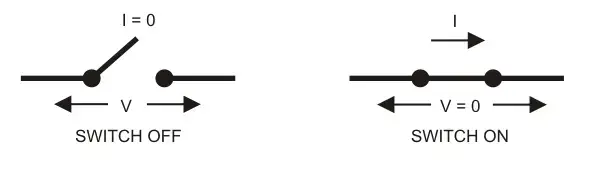
However practically there always exists a leakage current through the devices when in OFF condition, i.e Ileakage ≠ 0 and there is always a forward voltage drop in ON condition, i.e Von ≠ 0. However the magnitude of Von or Ileakage is very less and hence the power across the device is also very less, in order of few millwatts.
This power is dissipated in the device and hence proper heat evacuation from the device is an important aspect. Apart from this ON state and OFF state losses, there are switching losses also in power electronic devices. This is mainly while the switch toggles from one mode to another and V and I across the device changes. In power electronics both the losses are important parameters of any device and essential in determining its voltage and current ratings.
Comments
Post a Comment